

Navigation

Archive for June, 2009


The Government Wants to Help you with Your Mortgage

Jun. 23rd 2009

Barack Obama and the rest of the federal government continues to roll out new initiatives designed proximally to help mortgagers in need, and ultimately to stimulate the ailing economy. At this point, pretty much everyone is eligible for help, regardless of what stage of the process they are at.
 
For those that already have a mortgage and are facing foreclosure, the government has pledged money to incentivize banks to grant loan modifications for qualifying mortgagers. “To be eligible, a homeowner must have a monthly mortgage payment larger than 31 percent of their gross income. The monthly payments of those who qualify are lowered to the 31 percent limit. Lenders can do this by reducing interest rates to as low as 2 percent, by extending the term of the loan to 40 years or by deferring principal.” Borrowers are then placed in a temporary program whereby they must make their reduced payments successfully for three months, after which points they see their loans permanently modified.
 
On the one hand, the Treasury Department is trying to make it easy for eligible borrowers to receive modifications: “About 100,000 homeowners across the country so far have been extended loan modification offers. ‘We are encouraging servicers to staff up, establishing a hotline for homeowners, looking for new tools to expedite this process, working with communities to get the word out about resources available to homeowners,’ ” declared the department’s spokesperson.
 
At the same time, those who have applied tell stories of long waits, lots of uncertainty, and probable rejection. There are two related reasons for this discrepancy. First, there is a lack of lender impetus to facilitate loan modifications: “Housing counselors say that while 15 lenders — including major ones like Bank of America, CitiMortgage, Chase and Wells Fargo & Co. are participating, many have yet to fully train people to process the applications. As a result, housing counselors say they often receive mixed signals, with different lenders offering different interpretations of the guidelines.”
 
Second, the mortgageholders (i.e. investors) have the ultimate say in whether a mortgage can be modified. In situations where the value of the mortgage exceeds the value of the home, investors are more willing to agree to modification, because a foreclosure would result in lower remuneration. In relatively healthy markets, however, investors are more reluctant, especially since all of the incentives are directed towards the banks.

Ultimately, “One thing is clear: Homeowners who have a HUD-approved housing counselor championing their cause are more likely to get a modification than those who try it on their own. Housing counselors say they often understand the program’s guidelines better than the people answering phones for lenders, so they know how to pursue a case aggressively.”
 
Stay tuned for tomorrow’s post, where I will outline the homebuyer tax credits and the implications of the proposed Consumer Financial Protection Agency…
Posted by Adam | in foreclosures | No Comments »


Are Falling Home Prices a Symptom of Low Appraisals?

Jun. 11th 2009

Along with predatory lenders, ignorant homebuyers, and greedy investors, overly optimistic appraisers have been one of the main targets of those looking to mete out blame for (the collapse of) the housing bubble. Specifically, appraisers have been criticized for their lofty valuations, which may have contributed to “excessive” house price inflation. Appraisers counter that they were only doing their job, and that the real blame lies with the lenders that pressured them into simply confirming sale prices in order to make sure that deals closed.

Now, however, the pendulum may have swung too far in the opposite direction, such that appraisers have suddenly become overly conservative. Again, the appraisers blame the lenders, who this time around are driving appraisal valuations down in order to make sure that they don’t lend more than the home is actually work. “In some cases, lenders are requiring that appraisals be based on sales closed within the past three months rather than the prior six-month norm, appraisers said. Some lenders are also asking for comparisons with at least one sale in the past 30 days.” Also faulted is the new mortgage appraisal system, whereby home valuations are performed by appraisal management companies. While the change was supposed to prevent banks from directly pressuring appraisers by placing a buffer between them, the actual result was to commoditize the appraisal and drive down quality.

A similar trend can be seen in the rise of Broker price opinions, or BPOs, which “are performed by real estate agents who, unlike licensed appraisers, have no regulatory oversight of their valuations. BPOs are attractive for lenders because they cost between $40 and $65, compared with about $350 for an appraisal.” Meanwhile, since the agents have also been engaged to sell the property, they are incentivized to keep prices low, in order to maximize the chances of a sale. [It should come as no surprise that BPOs are illegal in 23 states].

The result is that appraisals are still leading the market, only this time around they are tugging prices downward instead of dragging them upward. Naturally, homeowners are furious. “When the homes are then sold at ‘fire-sale prices,’ the rest of the neighborhood suffers, especially in areas with clusters of distressed sales,” which is causing prices to fall across the board. Some home-sellers are being forced to drop their prices at the last minute in order to hold onto buyers with appraisal contingencies built into their mortgage contracts.

Homebuilders are also suffering since banks will no longer approve mortgages for properties that are determined to be overvalued, with the result that some new homes are being sold below cost. Meanwhile, those looking to refinance or take out home equity lines of credit are facing an uphill battle. Appraisals are coming in so low that creditworthy borrowers are being rejected outright for refi’s and/or watching the bank freeze their LOCs.

The keys to making sure that you get an appraisal that you’re happy with is to understand how the appraisal process works and then to double check the final report for errors. Most appraisals use a weighted average of the estimates from a sales comparison approach, income approach, and cost approach. Begin by making sure that comparative sales are actually comparable, and that there are not a couple of questionable homes dragging down the average. From a cost perspective, make sure that the appraiser took accurate stock of your home. For example, did he factor in all of the rooms and all of the renovation work you have completed recently?

In the end, unfortunately, appraisal is more of an art than a science. In other words, prices are constantly fluctuating and your home’s “true” value might be different yesterday from tomorrow. Really, a home, like anything else, is only “worth” what somebody else is willing to pay for it.

Posted by Adam | in home prices | No Comments »


Is the Housing Market Stabilizing?

Jun. 9th 2009

This last week saw a flurry of data, painting a predictably contradictory picture of the housing market. The debate over whether housing prices have stabilized now looks something like this: “House Prices Have Bottomed;” “No They Haven’t;” “Yes They Have;” “Not Yet!” That’s not to say that the conclusion is that in fact housing prices have not yet bottomed, but instead that “evidence” can be found to support either conclusion and also that there is unreported data muddying the picture.

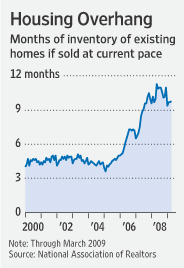
On the plus side, pending home sales rose 6.7% nationally in April, and even faster in some regional markets. Previously owned U.S. homes rose by 2.9% over the same period. Meanwhile, “Existing-home inventories are down to 9.8 months’ supply, higher than their long-term average of six months, but off their recent peak of 11.3 months.” [See chart below courtesy of WSJ] In other words, almost all of the data points appear to be either improving, or at least slowing in their rate of decline…..that is, until you look at what’s not being directly captured by the numbers.

Housing Inventory

First of all, the data itself is prone to manipulation, since much of it is self-reported, rather than compiled in accordance with some kind of universally-accepted standard. For example, pending home sales are being booked earlier and earlier, such that a smaller percentage are ending in actual sales. “A 33-percent jump in pending sales from February to March, for instance, did not bring a corresponding increase in closings a month later. In fact, April closings were up less than 4 percent from March.” As a result, “closed sales went from 89 percent of the previous month’s pending sales in June to 80 percent in July and have ranged from 60 percent to 84 percent since.”

Then there is the inventory data, which by its very nature doesn’t reflect homes whose owners would like to sell, but haven’t yet been listed. “There is a massive shadow inventory of bank- and investor-owned homes, enough to push existing-home supply to 12 months, notes one economist.

Ultimately, a full housing recovery is unlikely for as long as house prices remain depressed. The data and analysis surrounding this question is perhaps the most nuanced.

On the one hand, “The Federal Housing Finance Agency’s quarterly purchase-only house price index shows nationwide home prices fell 0.5 percent from the fourth quarter 2008 to the first quarter 2009,” compared to a decline of 3.3 percent in the previous quarter. An analysis of San Diego, where the housing market collapse was especially sever, indicated that prices are now well below their long-term average.

On the other hand, “Healthier regions, including ‘many parts of the Northeast, have only just begun to suffer price declines…Together, these factors could drag on prices through much of 2010, pushing the Case-Shiller index to a total decline of 40%.’ ” (It has already declined by 27%). Banks are certainly conscious of this possibility and are taking longer to approve mortgages. Given that interest rates are now rising and mortgage applications are leveling off, it could be a while longer before the market really stabilizes.

Posted by Adam | in home prices | No Comments »