

Navigation

Archive for March, 2010


The Tax Consequences of Mortgage Debt Cancellation

Mar. 25th 2010
In 2007, the Mortgage Forgiveness Debt Relief Act was passed and, believe it or not, the IRS is now doing everything it can to help Americans take advantage of the law to save money on their taxes. And with (the new deadline) April 17 just around the corner, this campaign could not be more timely.
 
After reviewing the results of a rudimentary survey on the subject, I was shocked at the level of misinformation surrounding mortgage debt cancellation. A handful of respondents were completely unaware of this Act and assumed either that they would be taxed on their cancelled debt. Others were equally unaware of the Act but had otherwise assumed that debt cancellation of any kind can always be written off.
 
Allow me to clear things up: as a result of the law (and its recent extension), taxpayers will not be held liable for up to $2 million in cancelled mortgage debt from 2007 to 2012. This applies principally to short sales and foreclosures on underwater mortgages, as well as to borrowers whose mortgage debt was cancelled (or not!) due to bankruptcy or insolvency. That’s not to say that any losses associated with foreclosure or short sales can be deducted from income (a major difference!), but rather excluded (not subject to taxes).
 
There are a couple of qualifications that I want to mention. First, only $1 million in cancelled mortgage debt can be excluded if filing separately. In addition, the cancelled debt must be associated with a primary residence, and not for a vacation home, rental property, or business property. In addition, home equity debt is eligible for the exclusion, but only insofar as it was used for renovation or other home-related expenditures, and not to pay down credit-card debt, for example. [It should be noted that credit card debt and other loans can also be excluded if the cancellation is associated with a title 11 bankruptcy case or insolvency].
 
If your lender can cancelled more than $600 of mortgage debt, it is required by law to have sent you a 1099-C form by February 2, with the amount of cancelled debt and the fair market value of any foreclosed property clearly indicated. If you haven’t received this form or disagree with any of the figures, you are advised to contact your lender immediately. Otherwise, simply copy the numbers over to IRS Form 982 (Reduction of Tax Attributes Due to Discharge of Indebtedness) and file it with the other forms when preparing your taxes.
 
Bear in mind, finally, that this debt cancellation is the result of a special policy (due to extenuating circumstances) and you should expect that after 2012, the tax treatment of cancelled mortgage debt will revert back to normal. In other words, it will be taxed as ordinary income. This is something that you might want to consider if your mortgage is underwater and you are weighing your options.
For more information, you can consult the full IRS entry on the tax treatment of cancelled debt. If you are having trouble resolving a tax issue, you can contact the Taxpayer Advocate Service.

 

What You Need to Know about Option ARMs

Mar. 24th 2010
You’re probably wondering why I would be devoting an entire blog post to Option ARMs. After all, with the bursting of the housing bubble and the tightening of lending standards, such mortgages are all-but-impossible to obtain. During the height of the boom, however, they were extremely popular, and five years later, more than 1 million borrowers are still grappling with the consequences.
Option ARMs California and National 2010-2012
 
First, the basics: What is an Option ARM? Simply, it is an adjustable-rate mortgage that gives the borrower the option to choose how much he wants to pay each month. For this reason, they are often referred to as Pick-a-Payment loans. Typical Option ARMs offer four possible payments: fully amortized 15-year payment, fully amortized 30-year payments, an interest-only payment, or a lower minimum that doesn’t even cover the interest portion of the loan. Under this latter payment, the mortgage will amortize negatively, and the balance will increase over time.
 
There are a couple of features which make Option ARMs especially problematic. The first is that while the (minimum) monthly payment can only rise 7.5% per annum, it recasts every five years in order to make the loan fully amortizing. The result is known as “payment shock,” as the borrower is suddenly forced to make a much greater payment. The second feature is a limit to how long a borrower can continue to make the minimum payment. When the loan balance reaches 110%, for example, the borrower might be required to make the higher payment.
 
Option ARMs were initially only obtainable by relatively wealthy borrowers, especially those with irregular and/or seasonable incomes. In such cases, the flexibility associated with an Option ARM is a real benefit. In fact, Option ARMs can still be appropriate for those with very short time horizons (though not for speculators). During the housing boom, however, they were aggressively marketed to borrowers with promises of initial “teaser” rates as low as 1%, and claims that even by making the minimum payment, the value of the home would rise faster than the value of the loan. Other lenders used them as a basis for making larger loans to borrowers, since affordability ratios could be calculated against the minimum payment.
 
In 2005-2006, these loans accounted for 10% of all new mortgage issuance nationwide, and as much as 50% of mortgages in the most overheated areas, namely in Florida and California. Do the math: the first recast dates for such loans are five years later, or 2010-2011. Combined with the massive declines in housing prices, many borrowers will surely face some version of payment shock over the next couple years.
 
If this describes your situation, now is probably a good time to start talking to your lender, if you haven’t already done so. You might be able to obtain a loan modification. Otherwise, your best hope is for your lender to waive the $10,000 prepayment penalty that probably applies to your Option ARM and would otherwise kick in if you tried to refinance into a fixed-rate loan. Even if you have been making the fully-amortizing payment, you might want to consider refinancing, since variable rates could begin rising as soon as the end of this year.
 
If you’re in the market for a mortgage and your lender is still willing to offer you an Option ARM, I would think twice. Many borrowers assume they have the discipline to make the higher payment, but when push comes to shove each month, they opt for the negatively-amortizing minimum. If you’re determined to press ahead, shop around for the lowest margin (the spread that gets tacked on to a baseline index to determine your interest rate), and plan to make a fully-amortizing payment every month.
Posted by Adam | in financial planning, news | No Comments »


Changes to the Mortgage Tax Deduction?

Mar. 2nd 2010

Edit: the below blog post was published 7 years ago. We also recently covered the Tax Cuts and Jobs Act which goes into effect in 2018.


A new Congressional proposal would eliminate one of the distinguishing features of a (US) mortgage: the mortgage interest tax deduction. Critics of the deduction have long argued that it deprives the federal government of much-need revenue, that it contributes to home-price inflation, and that it doesn’t do much to spur home ownership. As a result, the consensus is that an alternative system needs to be legislated into existence, and it must be equitable, effective, and efficient.

Towards those ends, the Wyden-Gregg bill, which is currently working its way through the system, would either completely do away with, or scale back the deduction that many homeowners currently claim when filing their taxes. One proposal would impose a maximum income constraint of $250,000 on would-be filers, in order to address the concern that the deduction primarily benefits the wealthy. Another proposal would replace the annual tax deduction with a one-time homebuyer tax credit, amounting to perhaps $10K. Rest assured, however, since the bill doesn’t have much support – given current economic conditions – and it seems unlikely that the deduction will be phased out any time soon.

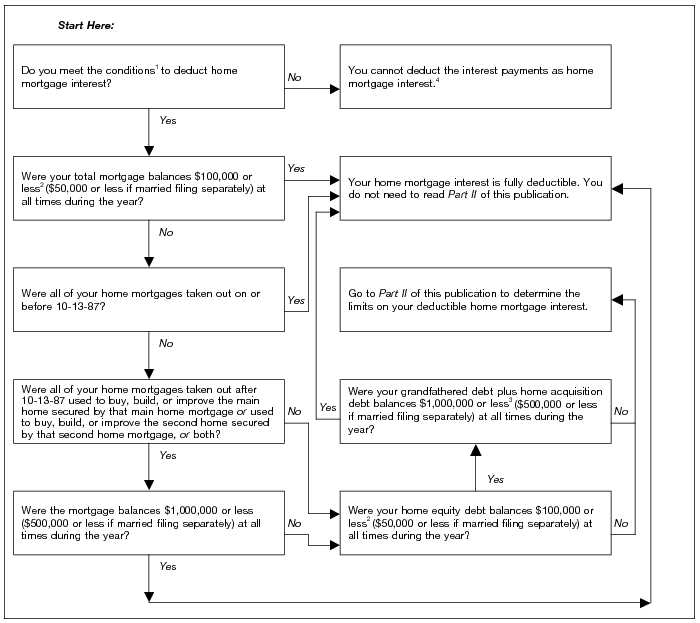
For the time being, then, you can still deduct interest on the first $1 million of mortgage debt, as well as all of your property taxes, for up to separate residences. (That’s $1 million all together, not each). In addition, you can also deduct interest costs on up to $100,000 for a home equity line of credit. For now, you can also deduct private mortgage insurance (PMI), but only if you bought your house  in 2007 or later. Property taxes – but not homeowners insurance – are also deductible. As with any aspect of the tax code, the mortgage interest tax deduction is much more complicated than you think, and there are a handful of conditions that must be met before you can claim it. The most important one is that you itemize when filing your taxes. For more information, refer to the IRS website, and review the flowchart below.

IRS Mortgage Interest Tax Deduction
If you are in the process of buying a home (and obtaining a mortgage), you can use our Real Estate Tax Benefits Calculator to estimate the savings associated with deducting your mortgage interest. Basically, the calculator will multiply your marginal tax rate by your estimated annual mortgage interest (as well as PMI and property taxes) to determine how much you will save as a result of the deduction. Given the uncertainty surrounding this perk, however, you would be wise to treat the savings as a gift, and not try to apply all of it towards a more expensive mortgage.