

• Mortgage Calculator Plugin
    Input Information
    Loan Amount ($)
    Interest Rate (%)
    Length of Loan (Yrs)

  • Categories

  • Archives

  • Blogroll

  • Pages

Archive for August, 2007

Retiring & the Problem With Saving $1,000 a Month

Aug. 17th 2007

Every person who tells you that if you had only been saving x dollars per month for retirement for the last y years does not account for inflation. 100 years ago, in 1907, the real GDP per capita was $5649 of year 2000 US dollars, but actual wages were much lower back then.

The original 1936 bay bridge connecting Oakland to San Fransisco only cost $79.5 million, but that amount is roughly 1 billion year 2000 US dollars.

The same misperception also occurs when you think about saving for retirement and carrying the numbers ahead a few decades. If you think $2,000 a month is enough to live on, what $2,000 are you thinking? $2,000 of today’s currency, or what that will be worth after inflation by the time you retire?

Saving money gets worse when central banks pour money into markets. Last Friday this report came out:

Worldwide, central banks have injected at least $326 billion (179 billion pounds) into their financial systems in the past 48 hours in an effort to prevent a global liquidity crunch that has its roots in the riskiest end of the U.S. mortgage market.

In its biggest single day of temporary open market operations in nearly six years, the U.S. Federal Reserve added $38 billion in reserves in three moves, the first coming before U.S. stock markets began trading.

This week the following numbers were released:

Over the past week, central banks around the world have injected hundreds of billions of dollars in cash into the financial system. The European Central Bank has added over $200 billion to its market, and the Fed added $62 billion to U.S. markets. The banks are attempting to ease tense conditions resulting from troubled lending markets.

Its hard to get anywhere saving money when the printers are running overtime.

Posted by admin | in retirement | No Comments »

US Mortgage Market Meltdown Hitting Diverse Markets

Aug. 17th 2007

Last year Yahoo! warned of lowered guidance due to a weakness in the financial and automotive markets. That weakness seems to be growing by the day. In Media Biz Paul R. La Monica highlighted the following about the online ad markets:

  • Countrywide was the #4 online ad buyer in July of 2007, with an estimated online advertising spend of $34.8 million.
  • Another mortgage provider by the name of Low Rate Source had an estimated spend of $46.3.

The mortgage crisis is hitting many businesses not even connected to mortgages.

Oneida Limited, a dinnerware and flatware maker, recently had to yank their plans to offer $120 million in high-yield bonds as the credit markets froze up seemingly overnight.

Firms in fields as diverse as wireless, restaruant, and motorsports have blamed the mortgage market for poor performance. Asian stock markets have also been hit hard of late.

Posted by admin | in news | No Comments »

Rating Junk Mortgage Credit as Quality High Grade Loans

Aug. 15th 2007

This WSJ article highlights how lenders shoped their loan portfolios to a wide array of rating firms like Standard & Poor’s and Moody’s, looking for the best rating, and taking their business elsewhere if the ratings were not as high as they would have liked:

When Wall Street first began securitizing subprime loans, rating firms leaned heavily on lenders and underwriters themselves for historical data about how such loans perform. The underwriters, in turn, assiduously tailored securities to meet the concerns of the ratings agencies, say people familiar with the process. Underwriters, these people say, would sometimes take their business to another rating company if they couldn’t get the rating they needed.

“It was always about shopping around” for higher ratings, says Mark Adelson, a former Moody’s managing director, although he says Wall Street and mortgage firms called the process by other names, like “best execution” or “maximizing value.”

Every rating system gets worked, from the lanuage used to classify investments (junk vs subprime) to how investments are mixed and rated. The problem with this sort of cozy relationship is that end investors typically remain ignorant to the process until it stops working. And then nobody could have seen it coming, but once the rating firms give a bit here or there the relationship heads down a long slippery slope that virtually guarantees it will fail. Even Alen Greenspan endorsed subprime loans, but now Angelo R. Mozilo, the CEO of Countrywide, said home prices were falling “almost like never before, with the exception of the Great Depression.”

Posted by admin | in fraud | No Comments »

American Express Mortgage Credit Card Rewards Program

Aug. 14th 2007

According to Mortgage News Daily, in May American Express announced a new credit card which allows home owners to charge their mortgages on their credit card. Enrollment in the program is not cheap, with a one time fee of $395, but if you charged a $2,500 mortgage to your card every month the card would pay for itself in about a year.

Some of the banks who have signed on to the program have already went bankrupt. It is yet to be seen if consumers will benefit from this new credit card, or it is just another way to help them get Maxed Out.

Posted by admin | in consumer credit | No Comments »

Mortgage Brokers Lie to Sell Homeowners ARM Policies as Fixed Rate Home Loans

Aug. 8th 2007

The NYT recently ran an article about how confusing the mortgage market is, discussing how adjustable rate mortgages are quickly sold to consumers under false pretense, then resold to other investment firms who are not held liable for fraud in the initial loan deal.

Even if circumstances suggest fraud when a loan was made, lawyers say, the various parties protect each other by refusing to produce documents.

Compounding the problem is a law stating that when a loan is passed to another party, that entity cannot be held liable for problems.

Even if the mortgage brokers outright lied to sell it, the consumer is stuck footing the bill until their house is foreclosed upon.

A borrower in good standing since 1998, she said a local broker persuaded her to combine her debts in a fixed-rate loan of $65,000 in 2003.

But at the closing, she was presented with an adjustable-rate mortgage from the Argent Mortgage Company, carrying a low teaser rate for two years. When she objected, the broker assured her that rates would fall and she could get a better fixed-rate loan later. She said she believed him.

The bait and switch pricing fraud may not be a few isolated incidents. In some cases, deceptive pricing may actually be a market standard. Last year the Pittsburgh Post Gazette published an article highlighting that Bankrate advertisers may offer one price on the Bankrate site, then charged another when consumers clicked through to the end merchant site.

If a consumer gets scammed it is their fault and they are stuck paying it. There is virtually no protection against mortgage fraud, especially for poor citizens who do not have enough capital to sue and reshape broken laws. Pretty sick, especially considering that the 2005 consumer bankruptcy bill was drafted by MBNA.

Posted by admin | in arm, fraud | No Comments »

Don’t Depend on Social Security Paying Your Mortgage

Aug. 5th 2007

zFacts published an article about the US National Debt vs GDP

In 1981 the gross national debt, compared to the nation’s annual income, reached its lowest point since 1931, 32.5%. It could have been paid off then more easily than at any time in the previous 50 years. Despite his claim to hate the debt, Reagan instituted unprecedented peacetime deficit spending. This is not partisan politics, this is straight off the White House web site.
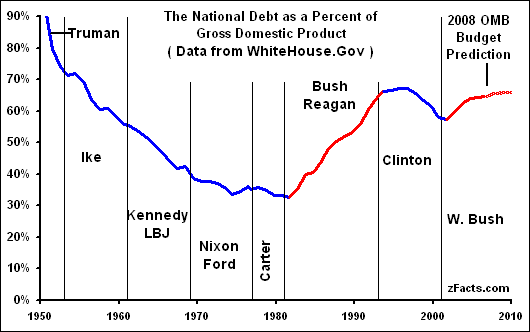
United States Gross National Debt vs GDP

Currently about half of the US government’s deficit comes in the form of borrowing from social security:

The gross (total) deficit is bigger because it takes into account that when the fed’s general fund (mostly military spending) borrows money from the Social Security Trust Fund, it will have to pay it back. Borrowing from Social Security is still borrowing. Deficit lite, which Bush is talking about, assumes there is no such obligation — that Social Security will not have to be paid back. So the more they borrow from Social Security the smaller is deficit lite.

President Bush has been lobbying to strengthen social security by privatizing it. Currently the social security system has a surpluss large enough that it helps the government cook the books by over $100 billion a year, but in about 15 years it will start costing the government more than it takes in. When it does that you can guarantee at least one of the following will happen

  • sharply higher taxes
  • sharply lower social security payouts
  • inflation (and rising interest rates) due to greater borrowing and an increasing currency supply

If you are counting on social security paying part of your mortgage you might be taking a big risk. Due to accouning fraud, the government is hiding nearly a half million dollars of debt owed by each US houshold. A recent USA Today article pegged the number at $516,348 per household. What happens to home mortgage interest rates the day we default on that debt?

Maxed Out: Covering US Consumer Credit Card Practices

Aug. 2nd 2007

Maxed Out is a great video and book covering the aggressive nature of banks and credit card companies.

It covers everything from

  • How credit card companies prey on college students with credit card offers even if they know the students have no way to pay them back
  • How some credit card companies hold checks to make payments late and charge late payment fees, overdraft fees, and . You can learn more about Providian Financial online
  • How it is far easier for companies to file for bankruptcy than individuals, especially since 2005
  • How the Bankruptcy Abuse Prevention and Consumer Protection Act of 2005 was written by MBNA - a leading credit card provider
  • How that law and others end up forcing many Americans into a lifelong debt, and cause those who are near the edge to fall off once something bad happens (like medical issues, debt, car accidents, etc.)
  • How reservist military members had to file bankruptcy because their pay was cut when they were placed on active duty in Iraq for 23 months straight
  • How inaccurate many consumer credit status databases are, and how Suze Orman has a deal with Fair Isaac
  • How large banks are fueling the payday advance loan industry by infusing those companies with large sums of cash

You can watch preview clips on the Maxed Out Movie website.

Posted by admin | in consumer credit | No Comments »

Mortgage Market Meltdown Facing Government Regulation

Aug. 2nd 2007

If you look at the 30 day trend at housing watch, MLS listing prices are down in all but 2 of the featured markets.

The ugliness is likely to only get worse as this meltdown spreads to other markets and the government starts getting more aggressive with market regulation. Rep. Brad Miller talked about how bankruptcy laws are robbing American home owners of their houses

Clip Syndicate also featured a great video with Andrew Busch of BMO Capital, discussing foreclosures and the pending meltdown of the subprime mortgage market, how it is effecting other markets, and how he is seeing increased attention from the Illinios government.

Posted by admin | in news, videos | No Comments »