Archive for July, 2010

Down-Payment: 20% is the Benchmark

Jul. 29th 2010

One of the aspects of mortgage lending that has changed the most in the wake of the housing bust is the down-payment. At the height of the boom, it looked like down-payments could soon become, well, if not extinct, than at least irrelevant. Nowadays, a sizable down-payment is not only essential to getting a loan with good terms, but also to getting approved for the loan in the first place.

The current benchmark for down-payment is 20% LTV. That means you are expected to pay 20% of the price of the property in cash, with the mortgage covering the remaining 80%. For those of you who can afford to make such a down-payment, statistics show that you will be comparatively likely to repay your mortgage. Thus, you can expect to receive extremely favorable terms on your mortgage.

The primary source of funds for this down-payment will probably be your own savings account. In some cases, you can also pledge securities (stocks, bonds, etc.) and the land that the property occupies assuming that you already own it. Lenders will also allow you to borrow against your retirement account (though in some cases this must first be approved by the administrator of your IRA) as well as to contribute gifted funds from family/friends, as long as the giver signs an affidavit pledging that the gift is not actually a loan.

If the target property was appraised for more than the purchase price, however, you cannot contribute the difference towards the down-payment, even though it is arguably equivalent to home equity. The only exception is if the seller is willing to raise the purchase price and contribute (most of) the difference to your down-payment for the loan. Such is perfectly legal and is known as a Seller-Assisted Down Payment. Bear in mind, however, that if the purchase price is raised to the point that it exceeds the appraised value of the property, this kind of arrangement will probably be rejected by your lender.

If you can afford to do so, you should consider making an even larger down-payment. Some lenders will compensate you by offering you an even more attractive mortgage rate. In addition, a larger down-payment combined with a shorter duration (i.e. 20 years instead of 30 years), would enable you to own your home in a shorter amount of time and save you money in the process (in the form of unpaid interest), all without affecting your monthly payment. If instead you were to continue to prefer a long-duration (30 years) mortgage, you can count on both a lower monthly payment and aggregate savings over the life of the mortgage.

For those borrowers that can’t afford – or simply don’t want – to make a 20% down-payment, you have a few options. First, you can apply to a Down Payment Assistance Program (DPAP); it’s advisable to ask your lender for advice, rather than solicit help on your own. If you’re eligible, you can consider a Veterans Administration (VA) loan, most of which don’t require down-payments. FHA Loans are also insured by (but not originated by) the government, and hence, require only 3.5% down-payments. This is offset by a more expensive loan, however, in the form a mortgage insurance premium, payable to the FHA to compensate for the increased likelihood of default.

For everyone else, you can expect to pay a hefty Private Mortgage Insurance (PMI) premium. Assuming your lender is still willing to underwrite your loan, despite a down payment that is below 20%, you will pay both an upfront PMI premium and an annual premium, until your home equity reaches 20% LTV. [Your home equity will gradually rise both as you repay the loan and if the value of the home appreciates].

Of course, the reality is slightly more nuanced. The actual importance of the down payment will depend on numerous other factors, including your credit score. In the end, you should first seek to understand the position of your lender before determining the size of the down-payment.

Loan Modification Program Yields Mixed Results

Jul. 25th 2010

The government has just released updated “report cards” for most of the participants in its HAMP mortgage modification program, and the results are…interesting. At this point, it can be labelled neither success nor failure.

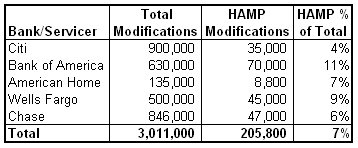
HAMP oversight stats 2010-06
As you can see from the chart above, an impressive 3 million modifications have been completed by the country’s five largest lenders, with Citi and Chase leading the pack, and Wells Fargo and Bank of America not far behind. However, there are a couple of disappointing sub-trends buried in this figure. First of all, the vast majority of modifications have been completed privately, outside of the government’s HAMP program. Second, the majority of borrowers that receive loan modifications ultimately go on to default anyway, which means the true number of borrowers that have been helped is far below the 3 million documented by the industry.

Let’s begin with the first issue- that loan modifications have been a largely private effort. On the one hand, this could be viewed positively, since only $250 million of public money (a small fraction of the the $40 Billion that was initially allocated by the government for the program) has been spent to date. This means that borrowers are being helped without the use of taxpayer funds. On the other hand, I think the correct – albeit cynical – interpretation of this situation is that lenders are deliberately circumventing the government in order to offer their own, watered-down modifications. Think about it – why would lenders pass up “free” incentive money from the government, all else being equal? The explanation is that the government’s modification program (HAMP) offers terms that are more favorable to borrowers than lenders wish to offer.

Since I’m on the subject of HAMP, it’s worth pointing out that only 390,000 borrowers have received permanent modifications. While this is nothing to scoff at in absolute terms, it falls far short of the number of borrowers that could benefit from assistance (10 million?) and even short of the government’s projection that 3 million borrowers would receive assistance from the program. The WSJ recently mused, “So how big a flop is HAMP? Modifications still face a high re-default rate, largely because borrowers still have heavy debt loads. Some borrowers have found themselves worse off because they do everything possible to get a trial modification, only to be turned down.” Still, the author of the story conceded that at the very least, the government’s program galvanized the private sector into action.

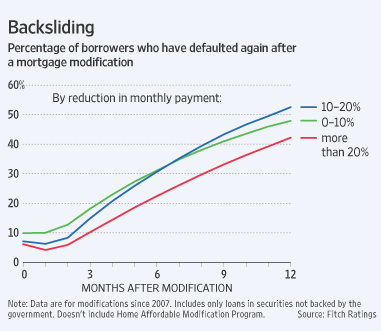
Mortgage Re-Default after Loan Modification
As I alluded to above, however, a significant portion of borrowers that receive modifications will ultimately default, or have already defaulted. As you can see from the chart above, half of borrowers (regardless of the extent of the modification) will default on their new mortgages within 12 months. That makes me wonder if the lull in foreclosures we have seen in some states – which have been attributed to loan modifications and other proactive efforts by lenders – might in fact be a mirage, and could perhaps re-emerge in a year or so, after a wave of re-defaults.

While the process of obtaining a loan modification is admittedly frustrating, lenders continue to grant them en masse, namely because they have determined that it is in their financial interest to do so. Thus, if you still think you’re entitled to a modification – whether private or HAMP – you should continue to harangue your lender. If your circumstances warrant it, chances are you will be granted one eventually.

Posted by Adam | in Loan Modification | No Comments »

Bank Bill and Mortgage Reform

Jul. 22nd 2010

The so-called Bank Bill is working its way through the US legislature, and depending on how negotiations proceed, the landscape of the US financial system could look very different after its completion. Of primary interest to me – and presumably, the readership of the this blog – is how the mortgage system will be impacted.

In its current form, the bill would effect changes to three main aspects: documentation, fees, and consumer protection. [The WSJ deserves credit for this classification]. In terms of documentation, lenders will be required to obtain full proof of borrowers’ assets and income, and to verify this information again immediately before the loan is closed. That’s not to say that no-documentation loans and stated-income/stated-assets loans will be disallowed; rather, it means that lenders that choose to make such loans will be required to maintain some “skin in the game.”

Specifically, a minimum of 5% of the loan balance must be funded directly by the lender, such that it has a direct financial stake in the repayment of the loan. [Currently, most lenders seek to maintain 0% exposure to most loans, preferring instead to sell them off to investors]. As a result, it is expected that the riskiest types of mortgages will become more expensive (to offset the higher risk to the lender), less common, and hence less disruptive to the mortgage finance system in the event of a crisis.

With regard to fees, there will probably be some kind of standardization, especially for vanilla fixed-rate mortgages. At the very least, lenders will be limited (or barred outright) from assessing prepayment penalties, especially on the riskiest types of mortgages. This way, borrowers that wish to refinance out of risky loans can do so without having to worry about being penalized by their lender.

In addition, mortgage brokers will probably be forbidden from receiving commissions in the form of Yield-Spread Premiums (YSP), because such creates a perverse incentive for them to steer borrowers into the riskiest and most expensive loans. Instead, “The loan originators could receive a commission based on the loan amount and bonuses on the [volume of] loans they do, but not based on the rates or the terms of the loan.”

Third, the bill would sponsor the creation of a new Consumer Financial Protection Bureau. This agency would have broad and far-reaching powers to monitor all aspects of the mortgage process. It would protect consumers from lender abuses, and presumably would require increased disclosure and counseling for borrowers that wish to obtain risky loans. It could also conceivably monitor the appraisal process, and to make sure it remains immune from the pressure of aggressive lenders.

Finally, the bill would allocate additional short-term funds towards the further alleviation of the housing crisis. There would be a $1 billion emergency homeowners’ relief fund and a $1 billion for redevelopment of abandoned and foreclosed homes. More information on this will be forthcoming if/when the bill passes. (A target date of October 1 has been set).

Interview with Patrick Duffy of Housing Chronicles: “Everything Eventually Reverts to the Mean.”

Jul. 20th 2010

Today we bring you an interview with Patrick Duffy of of the Housing Chronicles Blog. Patrick is also the Founder and Managing Principal of MetroIntelligence Real Estate Advisors, as well as a former Managing Director of Consulting with Hanley Wood Market Intelligence. Below, he shares his thoughts on housing prices, loan modifications, and the pros and cons of renting, among other topics.

Read the rest of this entry »

Posted by Adam | in Interviews | No Comments »

Mortgages and Credit Scores

Jul. 18th 2010

In the wake of the housing bust, lenders are sharpening their focus on borrowers’ credit scores. Putting aside how ironic this is – given that the credit score has proven to be a less-than-perfect indicator of creditworthiness – it’s vital that (potential) borrowers understand how the credit score will be used by lenders, and how the score can be maintained at an attractive level.

Before you even begin shopping for a mortgage, you should first make sure that your credit score is as high as possible. Ideally, this should be done a few months in advance, so that any changes are reflected in the credit score by the time it is pulled by the lender. Namely, you should double check your credit report for errors and pay off all of your consumer debt. If possible, you can try to borrow money from friends, so that your financial position appears to be as strong as possible.

Consider also that your lender will require additional financial information to supplement your credit score. You will be asked to furnish proof of your income and assets. If you are self-employed and/or unable to do so, you may be able to obtain a so-called Stated Income/Stated Assets Loan or No Documentation Loan. In light of the credit crisis, however, these loans are difficult to obtain. Even if your credit score is quite high, you should expect to pay a premium on your mortgage rate and make a larger down-payment.

Your credit score and financial attributes will be verified again upon closing. This is a new requirement, mandated by Fannie Mae on June 1: “If a broker or lender finds significant changes, the loan could be delayed, or in some cases, denied.” Accordingly, you should make sure that you continue to exercise the same prudence until the loan is officially closed. According to one analyst, “ ‘Just one point in a credit score can change things tremendously. And potentially, they may not qualify for the loan.’ ” At the very least, you might incur additional fees.

Finally, your credit score will continue to be affected depending on how diligent you are in repaying your mortgage. If you promptly make payments every month, your credit score will gradually improve.This will simplify the process of refinancing your mortgage or obtaining a new loan in the future. If you make even one late payment, however, your credit score will be materially impacted. If you default on your mortgage, your credit score will be devastated, and it goes without saying that you will have difficulty obtaining financing for anything for at least a few years.

In short, while the credit score is both annoying and even somewhat pointless, remember that lenders take it very seriously. Unfortunately, that means that you should do the same.

Mortgage Rates Fall, Housing Market Stagnates

Jul. 13th 2010

One month has passed since I last reported on mortgage rates, and I feel like I could reprint that same post and simply update the rates. But seriously, rates are still dropping and shattering records the whole way down. According to the latest Freddie Mac Primary Mortgage Market Survey, the average 30-year rate is an unbelievable 4.57%. A 15-year fixed-rate mortgage can be had for 4.07%, with the average ARM rate at 3.75%.

Freddie Mac PMMS July 8 2010
Even JUMBO rates have fallen: “Just a year ago, the average rate on a 30-year jumbo mortgage—a loan of more than $729,750 not backed by government-sponsored agencies Fannie Mae or Freddie Mac—was 6.86%…Now it is 5.48%—a rate that rivals those available during the height of the credit bonanza.” With the exception of subprime mortgages (which are no longer widely available), virtually every other type of mortgage can be had for an impossibly low rate.

Just for the sake of perspective, consider that mortgage rates are now at their lowest level since Freddie Mac began tracking them in 1971, and according to some sources, they are probably at the lowest level of all time. Whereas last year, pundits were clamoring to predict when rates would begin rising, now they are trying to outdo each other with low-ball forecasts. To be sure, some analysts are clinging to their original forecasts – based on the notion that rates will rise when the Fed tightens its monetary policy and unloads its hoard of Mortgage-Backed Securities (MBS) – but such voices have increasingly come to represent the minority.

Of course, these record-low rates come with a few caveats. First of all, borrowers who wish to qualify for them will need stellar credit. In addition, they should expect to pay .7 points (on average) to their lender. As if that were not enough, it turns out that much of the savings from lower rates is being reaped by lenders, in the form of a “growing difference between the cost of a typical 30-year mortgage and yields on securities guaranteed by government-supported Fannie Mae into which the debt gets packaged.” This spread was originally a remnant of the credit crisis, but has also been exacerbated by consolidation among lenders.

On the one hand, there is evidence that borrowers are taking advantage of low rates, as refinancing applications continue to surge. At the same time, mortgage applications for new home purchases are falling at an annualized pace of 30%, and now represent only 20% of all mortgage applications. In short, low rates are only part of the picture: “The decline we’ve seen in recent weeks is marginal in the sense that mortgage rates were already low. If an $8,000 tax credit didn’t get you off the sidelines, another little dip in mortgage rates isn’t going to do it either,” summarized one analyst.

While lot rates certainly make home-buying more attractive, it doesn’t alter the down-payment, nor does it offset borrowers’ concerns that home prices will continue to fall. High unemployment is also preventing demand from returning to pre-crisis levels. That means that the housing market probably won’t recover until the economy and the labor market first recover. Until then, mortgage demand and mortgage rates will probably remain low.

Posted by Adam | in home prices, mortgage rates | No Comments »

Strategic Default Update

Jul. 10th 2010

I recently came across a few interesting articles on Strategic Default (the decision to voluntarily stop paying one’s mortgage despite possessing the means to continue making payments), and I want to share them here.

The first was an article in the NYTimes (”Biggest Defaulters on Mortgages Are the Rich“), which sought to draw attention to the fact that wealthy borrowers are defaulting on mortgages in proportionally greater numbers than those of other economic strata. “More than one in seven homeowners with loans in excess of a million dollars are seriously delinquent” compared to “About one in 12 mortgages below the million-dollar mark is delinquent.”

Delinquency Rate Strategic Default Wealthy $1 million borrowers

Analysts have surmised that a large portion of defaults by the wealthy are deliberate. According to this line of thinking, the wealthy are inherently more “shrewd” and “ruthless,” and hence, they have no qualms about voluntarily walking away from an underwater home, in much the same way that they wouldn’t hesitate to dump a faltering investment. From my point of view, though, it seems equally plausible that those with expensive homes are necessarily more likely to involuntarily default, since repaying an expensive mortgage places a bigger burden on the borrower.

According to another story (”Fannie Mae Gets Tough With Walk-Away Mortgage Defaulters“), meanwhile, Fannie Mae is well aware of the strategic default phenomenon and is now ready to take action to curb it. Those who are found to have strategically defaulted (i.e. cannot demonstrate indigent financial circumstances) will be barred from obtaining a new mortgage for seven years. In addition, Fannie will actively seek deficiency judgements against borrowers in states that allow them to do so.

Borrowers that had no choice but to default will not be punished excessively. They will be locked out of the mortgage system for three years. If they agree to sign a Deed in Lieu of Foreclosure, this sentence will be reduced to two years. In short, it’s important to remember that defaulting (whether involuntary or strategic) carries real consequences. Personally, I think strategic default is an economic (rather than a moral) decision, which means it can be made rationally. Still, borrowers should understand that like any economic decision, there are drawbacks as well as benefits.

According to the final article, however, all of this talk might be moot. There is evidence that the strategic default trend is already peaking: “After a seasonal reduction in both measures from Q4 2008 to Q1 2009, the Q2 [2010] numbers then declined further, breaking the historical trend of quarter-over-quarter increases.” This is probably due to a stabilization n home prices, such that borrowers that were contemplating strategic default have probably already so. Of course, if home prices resume their decline, strategic defaults could likewise increase.

Posted by Adam | in foreclosures | No Comments »

Interview with Raul Black of HousingCorrection.com: “The market will eventually heal itself.”

Jul. 8th 2010

Today we bring you an interview with Raul Black of HousingCorrection.com, which contains a collection of online house valuation tools. Below, Raul shares his thoughts on housing prices, buying versus renting, and foreclosure.

Mortgage Calculator: I’d like to begin by asking you about your background. What made you decide to join the ranks of housing watchers? How would you summarize your approach to the (current) housing market, and how has your background informed this approach? 

In 2005 I began searching for a house near my place of employment in order to reduce my 3-hour round-trip commute. I couldn’t help but notice everything in my region seemed overpriced. I began exploring housing data in an effort to understand why prices appeared to be unsustainably high. I wound up becoming hooked on the subject matter.

My approach to understanding the housing market is highly data-concentric, which fits well with my occupation as a data analyst. Unfortunately, data tells a large part of the story, but it doesn’t tell the entire story. If prices maintained strict relationships to popular fundamentals, we would have never had a housing bubble. Thus, I attempt to balance my data-driven approach with other techniques such as observing market psychology and using good old fashioned common sense.

Since random unforeseen future events have not been captured in my historical data sets, betting the farm on a promising historical pattern is not my goal. Instead, I attempt to assign relative probability measures to various potential outcomes and continue to adjust these forecasts as new data arrives and my understanding of the subject increases.

Mortgage Calculator: It seems both the housing bubble and its bursting have been characterized by important regional disparities, so it’s not really meaningful to make generalizations on a national basis. Do you think that the recovery, whenever it cements itself, will also adhere to this pattern? Based on the data that you diligently display on your website, are their some markets that you would avoid, but other areas that you would gravitate to? 

The price of each region is a function of local, national, and global economic factors. In my opinion, global and national economic factors (such as the Fed’s open market operations) will continue to influence price, but so will each region’s individual economic situation. Thus, we’ll see general national trends accompanied by continued price disparities among regions.

Northwest cities such as Seattle, WA and Portland, OR have a high probability of continued depreciation due to prices being well out of line with historical fundamentals. Despite prices being extremely cheap by historical standards in Phoenix and Las Vegas these areas still have extremely high foreclosure heat and will most likely continue to correct. Further east, I’m negative on Chicago and New York. That’s kind of a popular forecast of the Case-Shiller 20, but it fits well with what I’m seeing.
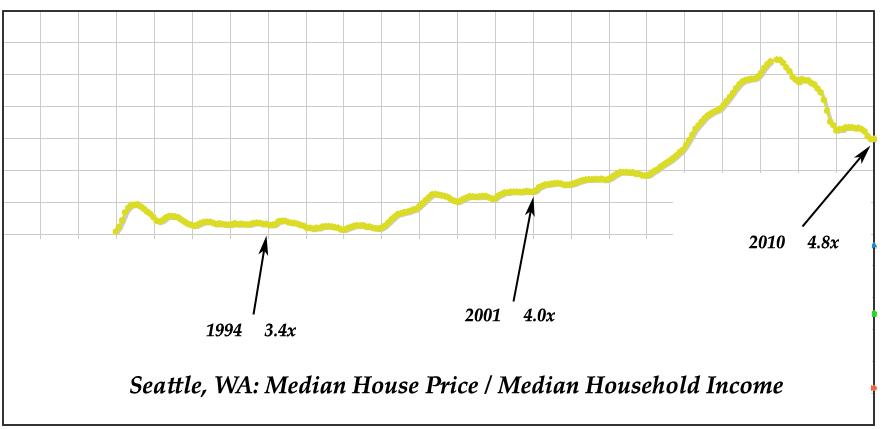
Seattle - Median House Price - Median Household Income Ratio

There are areas in the U.S., such as Sioux Falls, SD and Lincoln, NE that have remained more immune to the housing bubble and the national economic downturn than others. Buying into this pattern is a safer bet than buying in cities that ran way up in price, got nailed by the economic downturn, and have yet to come back to earth.
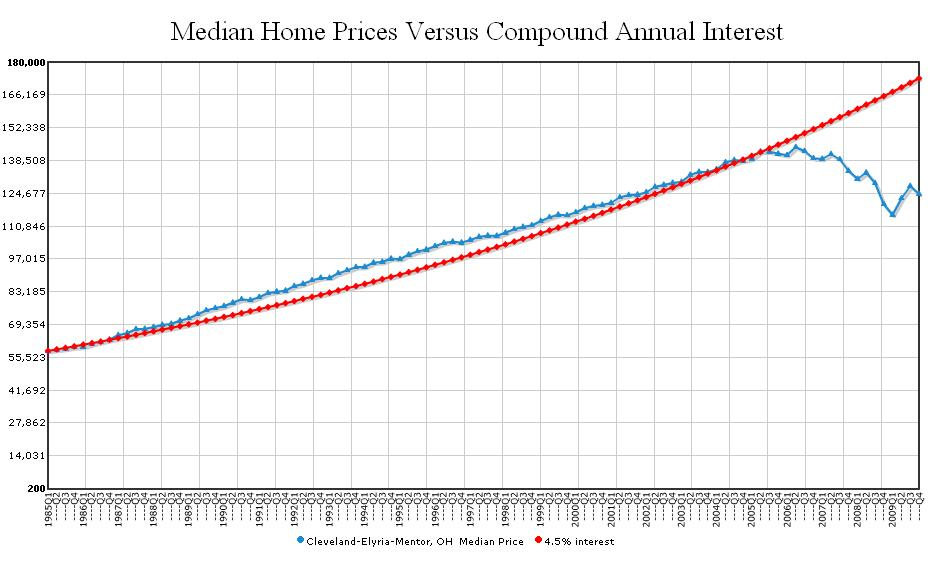
Median Home Prices Versus Compound Annual Interest 1985 - 2009

(Cleveland appreciated 4.5% per year from 1985 to 2006, eventually giving way to a rocky local economy.

Areas, such as Cleveland, that appreciated at a steady rate over the long term and were hit by the economic downturn could be setting up for modest gains if the economy continues to improve.
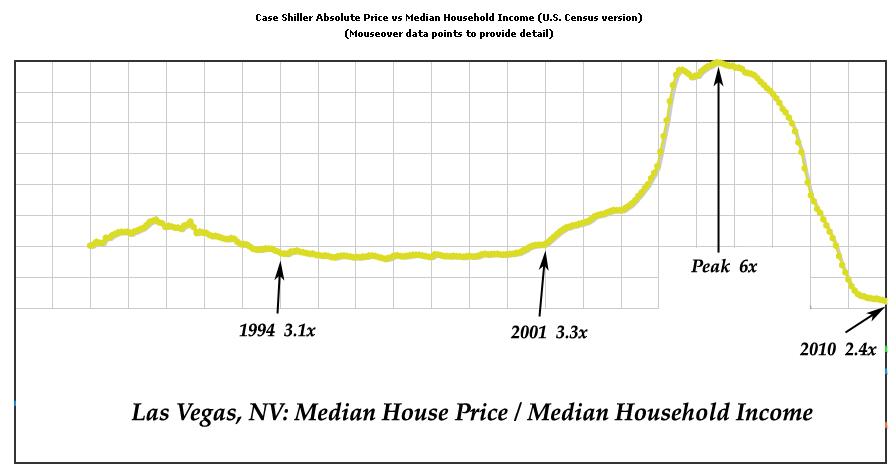
Las Vegas - Median House Price - Median Household Income Ratio

Given time, bubble cities such as Vegas will look like outrageous bargains. But don’t jump too soon, or you could get burned by continued foreclosure problems.

 Mortgage Calculator: What do you think it will take for people to accept the notion that home prices don’t appreciate much faster than the rate of inflation, over a long-term period of time?

I think the short answer is time. It will most likely require several years before people develop fresh memory patterns that become etched deeper than the memory of their euphoric bubble experience. In the meantime, I believe lots of people will lose their homes and their money. Losing money tends to have a sobering effect on optimistic mania.

 Mortgage Calculator: HousingCorrection.com suggests that housing prices will continue to fall. Is this based on the forecasting tools available on your website, other experts, or your own intuition?

It’s based on a combination of all three factors. Using data-driven techniques, I have attempted to test a number of experts’ forecasts. In doing so, I’ve learned at least as much from others as I have from studying the data. As for intuition, I believe it can be a powerful tool when used in limited amounts. However, it’s important to not get intuition confused with emotion. In my experience, emotion-based decisions generally yield a poorer return on investment than decisions arrived at through logic and intuition.

 Mortgage Calculator: The data suggests that foreclosures will continue to rise. Do you think that government programs and lender initiatives will be enough to forestall this? Do you think that strategic defaults will continue to be a factor? 

I trust what the data says. Foreclosures will continue to cause distress in the market for the next several years.

The government is good at applying bandages that temporarily conceal gaping wounds, but they have little experience fixing deep underlying economic problems. A good example is May existing house sales. Most experts expected more homes to sell in May than April due to buyers having rushed to beat the tax credit deadline. But when the data came out, it showed that sales dropped. The government has a poor reputation when it comes to bang for the buck.

Bringing back high-paying jobs in this country is a much better fix for the housing market than government gimmicks aimed at propping up prices above what people can afford to pay. Our nation’s leaders have thrown a kitchen sink full of expensive gimmicks at the foreclosure problem; yet, RealtyTrac track indicates bank repossessions hit a record monthly high in May.

Knowing that the government’s ability to bring house prices back to bubble levels is severely restricted, who wouldn’t be tempted to mail their keys back to the bank if they were underwater on their home? Despite what most real estate agents claim, homes typically represent highly leveraged investments. When you gamble and win, it’s great! When you gamble and lose, you renege. The banks did it, and homeowners are doing it too. If provided a path, it’s human nature to walk away from bad deals.

Mortgage Calculator: Do you generally believe that renting is more economical (and more sensible!) than buying, even when the ratio of rent to home prices is more in line with long-term averages? 

I believe different people extract different forms of value from homes. Owning a home within your financial means can provide a sense of belonging, stability, and security. However, that same home outside of your financial means becomes a nightmare. On the other hand, renting relieves occupants of numerous responsibilities and allows packing up and moving without having to pay 8% of the home price for taxes and real estate commissions.

It is up to each individual to measure the value they get out of renting the home compared to purchasing it. From a purely investment standpoint, I would be very reluctant to purchase a home in my area that is not rentable as cash-flow positive after having put 20% down. Anything outside of this range sets off warning signals for me. If a home doesn’t make financial sense to me as an investment, it doesn’t make financial sense as a personal residence. 

Mortgage Calculator: How would you reconcile government and seller incentives and low interest rates with the possibility that home prices could fall further, when advising someone thinking about buying their first home? Would you advise them to buy, wait for a while, or wait forever?

Government incentives are great for house sellers but they are not always favorable to house buyers—especially when offered at the bust end of a pyramid scheme. They tend to temporarily inflate prices but, once the support is withdrawn, prices continue to correct. With seller incentives buyers pay more in order to get perks that must be paid for over the life of the loan. Low mortgage rates only make sense if you are buying in an area that has overcorrected to the point of prices being cheap by historical standards. Otherwise (barring wage inflation) when rates go up, house prices will go down so that buyers can afford the monthly payments.

It’s typically very difficult to save a down payment because rising home prices eat into the cash you save. The current environment of flat to declining home prices provides an unusually good opportunity to live frugally while saving up down payment equity. In most cases, I recommend keeping an eye on the jobs data in your area, as it is a leading indicator of where house prices are heading. While unemployment is high, saving a down payment is a much safer bet than attempting to catch a falling knife.

Ultimately, whether to buy or wait depends on your job security, the area where you live, what your specific needs are, how long you plan living in the home, your views on future inflation and the future of jobs in your region, and several other factors. If you’ve decided you need to buy a house, don’t buy the first house you see, and don’t depend on your real estate agent to be the expert. Do your own research and become informed about your specific market. In addition, it’s important to keep your impulsivity and emotions in check during the buying process.

In my opinion, the market will eventually heal itself. Increasing population growth accompanied by record low building starts will eventually improve the supply/demand ratio. It’s important to become an informed buyer in the meantime. This provides insurance against becoming one of the millions of foreclosure casualties throughout the country.

Posted by Adam | in Interviews, Uncategorized | Comments Off

Mortgage or HELOC: Which to Pay Off?

Jul. 4th 2010

Many of those that have an outstanding Home Equity Line of Credit (HELOC) loan are debating whether to withdraw additional funds in order to pay off their primary mortgages.

On one level, this probably seems like a silly question/notion, since it essentially involves substituting one loan for another. However, consider that HELOC loans typically accrue interest at variable rates while most primary mortgages accrue interest at a fixed rate. Those for whom such is the case can thus reap immediate savings on interest by withdrawing additional funds under their HELOC in order to repay their primary mortgage.

Of course, there are a couple problems with this approach. First of all, it ignores the possibility that variable rates may soon rise, to the extent that they exceed fixed rates. Under such a scenario, anyone who exchanged their primary mortgage for a HELOC would end up paying more interest. Second, there is a school of though which holds that a HELOC should be repaid before a primary mortgage, and in fact, this idea was confirmed by a recent study, which demonstrated that those who obtain home equity loans are more likely to default on their primary mortgages.

On the other hand, there is no indication that variable rates will rise anytime soon, let alone to the point where they would exceed fixed rates.The Fed has conveyed that rates will remain low for an extended period of time, and when it finally moves to adjust its benchmark Federal Funds Rate, it will probably move slowly. Thus, anyone who used their HELOC to repay their mortgage would probably save money for at least a couple years. Beyond that, it’s hard to predict where mortgage rates will stand.

Another approach would simply be to refinance one’s primary mortgage. While variable rates are currently near record lows, fixed rates are as well. Why risk a rise in variable rates if you can lock in a fixed-rate that as nearly as low? If, however, your credit is not strong enough to qualify for a refinancing, this is not an option. Instead, you can spend 1-2 years rebuilding your credit, before re-applying. If you are confident that you can stand the risk, you can shift the balance of your loan over to your HELOC, and save money in the interim.

Posted by Adam | in mortgage refinancing | 1 Comment »


Free Mortgage Calculator for Your Website!

Would your customers benefit from a free mortgage calculator on your website? Learn how to add a calculator to your website in less than a minute - FREE!